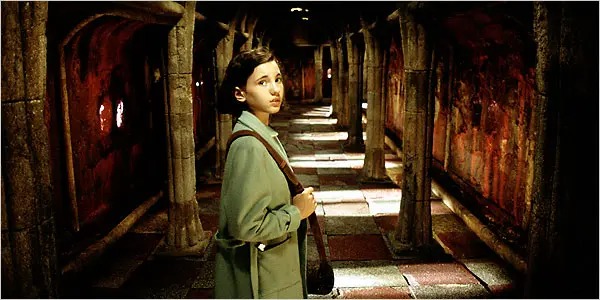
Mise-en-scene in the Pale Man Sequence
Mise-en-scène in this sequence plays a prominent role in conveying themes and reflecting meaning. The scene begins with Ofelia in her room, observing the fairy tale book that guides her throughout her adventure. The pale man appears on the page in the shape of a uterus, similar to the tree where Ofelia meets the toad. This represents her rebirth into womanhood; her experience was an awakening, and it causes her to lose her purity and become more mature. The lighting in her room is low-key, dark and melancholic, which represents the oppressive nature of Vidal and Spain. However, after she climbs through the door, the lighting becomes softer and more high-key, creating a false sense of security, as the context of the scene is a juxtaposition; the scene is not warming or comforting in the slightest. The Pale Man’s lair has connotations of hell; it’s underground, and the lighting implies a fiery, hellish aesthetic, which is further emphasised by the fireplace behind the Pale Man.
The pile of shoes in the corner of the room represents the destruction of innocence and childhood in the holocaust, further reflecting one of the film’s main themes, the loss and destruction of innocence. This motif is consistently evident throughout this sequence; for instance, the haunting infant murals on the ceiling directly reference Francisco Goya’s painting of Saturn Devouring His Son. Another direct reference to this artwork is when the Pale Man kills the fairies by decapitating them; their blood symbolises the violence and destruction of innocence, as the fairies represent childhood and purity, and this effectively mirrors the real-world violence that Vidal inflicts upon Ofelia.
The setting of this sequence directly mirrors the banquet scene previously seen, with the table full of food and with Vidal at the head of the table; however, in the Pale Man’s hall, it’s just as lavish, and still laying out a table of food, but the lifeless and empty spaces convey decay and corruption, both banquets represent greed and shows the dominant, upper class indulging while the innocent suffer, furthermore, the grapes that Ofelia can’t resist represent the temptation of the Forbidden Fruit, similar to the story of Adam and Eve. The stone walls and flickering candles create a claustrophobic, tomb-like atmosphere, with the colour palette being overtaken by muted browns, yellows and greens, which create a sickly, unsettling aesthetic.
0 Comments Add a Comment?